Why Is My AI Video Ignoring the Reference Image?
Brightory creates practical AI guides and workflows based on research, testing, and documented AI usage patterns.
Use references that are clear, compatible and specific about what each image is meant to preserve. Add another angle only when it resolves missing visual information; more references are not automatically better.
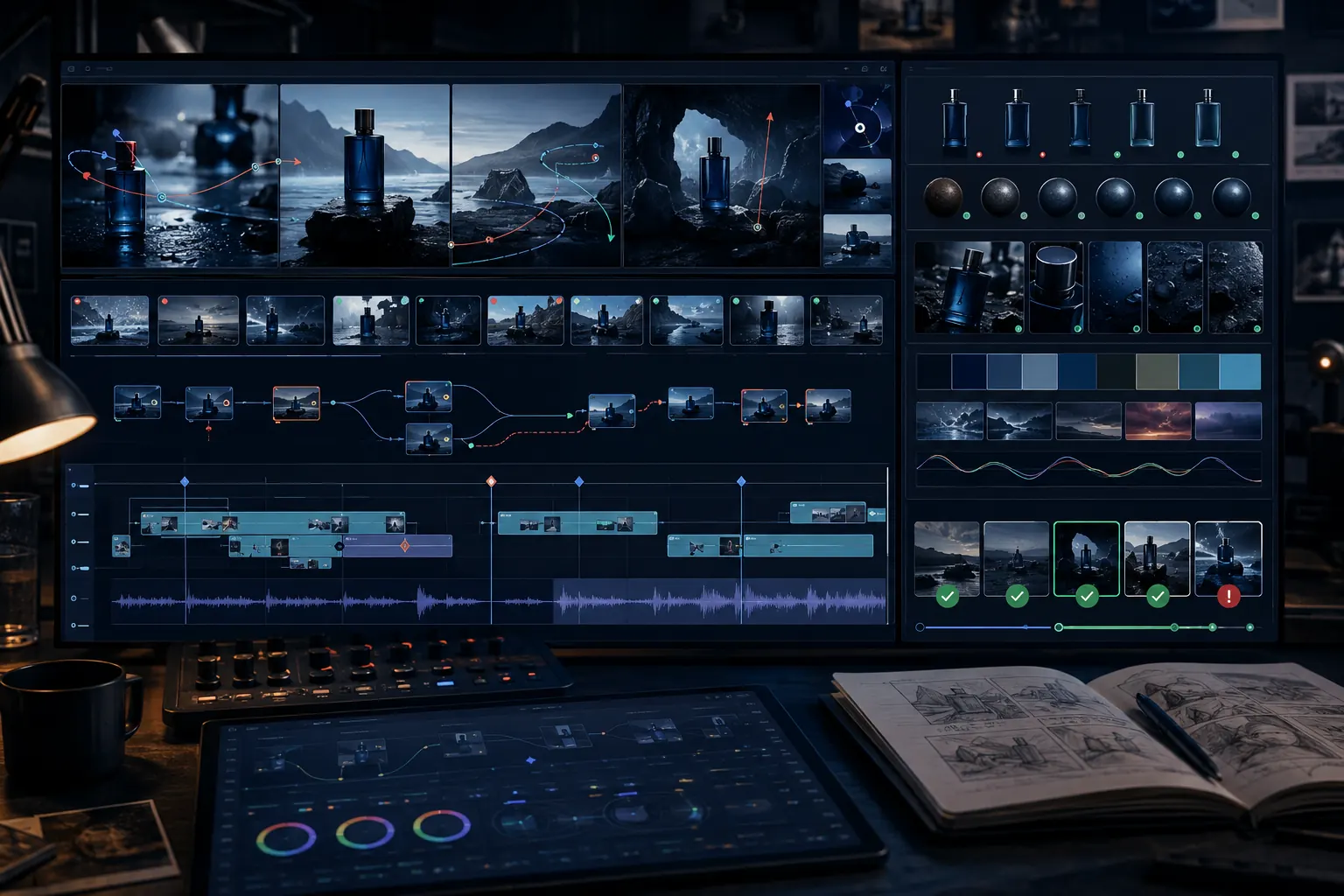
Use references that are clear, compatible and specific about what each image is meant to preserve. Add another angle only when it resolves missing visual information; more references are not automatically better.
What is actually failing
This is a reference control problem, not a signal that you need a longer prompt. Modern video models can follow references and motion instructions, but every new angle, occlusion, contact point or camera move introduces visual information the model must infer. The safest workflow is to identify which state must remain fixed and which state is allowed to change.
Use a locked-state workflow
- Choose the last known-good state. Save the approved reference or clean frame before changing anything.
- Write down the invariants. Keep a short list of details that must not change; do not bury them inside prose.
- Change one production variable. Add the new action, angle, camera move or interaction without redesigning the subject.
- Reduce ambiguity. If the shot fails, simplify motion, shorten the clip, expose the subject more clearly or add the missing reference angle.
- Verify before extending. Only use a clip as the next reference after it passes a frame-by-frame continuity check.
A prompt structure that is easier to debug
LOCKED:
- subject / product identity: [unchanged]
- wardrobe / materials / colors: [unchanged]
- location anchors: [unchanged]
- lighting direction: [unchanged]

CHANGE ONLY:
- action: [...]
- camera: [...]
- start state: [...]
- end state: [...]

DO NOT INTRODUCE:
- new wardrobe, props, cuts, camera angles or redesigns
- changes to logo, facial identity, product proportions or scene layout
When another reference helps — and when it hurts
Keep motion complexity below the fidelity limit
Verification checklist
- Does the face or product silhouette remain stable at the hardest point of motion?
- Do hair, wardrobe, labels and accessories survive the whole clip?
- Are start position, end position and screen direction correct?
- Did the model add an unrequested cut, prop, person or camera move?
- Can the final clean frame safely become the starting reference for the next shot?
Where the AI Video Kit fits
Keep the method. Skip the repeated setup.
When my AI Video Ignoring the Reference Image comes up again, you should not have to rebuild the operating process from scratch. The Brightory AI Video Consistency & Production Kit packages this kind of work into continuity sheets, shot-planning templates, reusable prompt blocks and production QA checks, so you can carry the method into the next project instead of starting over.
Identity continuity benchmark
Identity drift appears most often where references stop supplying information: unseen angles, occlusion, scale changes or competing reference subjects.
- Match reference coverage to the angles the shot will reveal.
- List a short set of identity invariants.
- Avoid contradictory reference images.
- Recover after occlusion from a known-good reference state.
- Approve identity at the weakest angle, not the beauty frame.
Acceptance test
A reviewer should identify the same subject from the weakest frames without relying on costume or scene context alone.
Decision rule
Character consistency is reference coverage + invariant checks; a prompt cannot fully specify visual information the references never show.
Identity QC matrix
| Check | Compare | Reject when |
|---|---|---|
| Face/profile | Outline, hairline, nose/chin and age cues. | Weak angles imply a different person. |
| Body | Height/limb/shoulder proportions. | Scale changes with shot size. |
| Wardrobe | Cut, color and distinctive details. | Unseen surfaces are invented inconsistently. |
| Occlusion recovery | Before and after hidden frames. | Identity changes when the subject reappears. |
Worked example: approve the turn at its hardest frame
If a character is stable front-facing but changes during a three-quarter turn, keep the scene and prompt stable and add a relevant profile/three-quarter reference if supported. Run the shortest shot containing the turn.
Compare face outline, hairline, profile and body proportion at the exact frame where drift previously appeared. If the reference fixes that point, promote the result. If not, reduce the turn or occlusion before changing unrelated prompt details. The hardest frame—not the prettiest one—decides whether the sequence is safe to continue.
Operational notes for this workflow
Reference coverage should match the shot. If the character turns profile, back-facing or passes through occlusion, include the clearest available reference for those states rather than expecting a front portrait to define hidden geometry. Keep the invariant list short enough to audit frame by frame.
Judge identity at the weakest frame and after reappearance from occlusion. If the model only resembles the subject in the opening frame, the clip is not a reliable continuation source.
Final continuity checklist
- Known-good state: did this test begin from an approved reference, frame or clip?
- Single delta: can you name the one visual or motion variable that was allowed to change?
- Weakest frame: did you inspect the highest-motion, most occluded or most oblique frame rather than only the opening image?
- Boundary: does the shot connect cleanly to the state before and after it?
- Promotion rule: would you trust this exact result as the reference for the next generation?
If the answer to the final question is no, the clip has not passed continuity even if several frames look excellent. Repair the failed state before extending the sequence.
- Runway — AI Character References: Tips & Techniques
- Runway — Gen-4 Image References
- Google AI for Developers — Veo 3.1 reference images
- Adobe Firefly — Motion reference
- Adobe Firefly — Generate videos using images / first and last frames
AI video controls differ by model and can change quickly. The workflow below distinguishes durable production practice from model-specific features; re-check the linked official documentation before relying on a current limit or control.