How to Hand a Large Unity Project to GPT-6 Astra Without Letting It Change Unrelated Systems
Brightory creates practical AI guides and workflows based on research, testing, and documented AI usage patterns.
Do not start with “understand my whole game.” Give Astra a project map, one objective, an allowed-change boundary, and an explicit inspection phase. Expand context only along dependencies that the task actually touches.
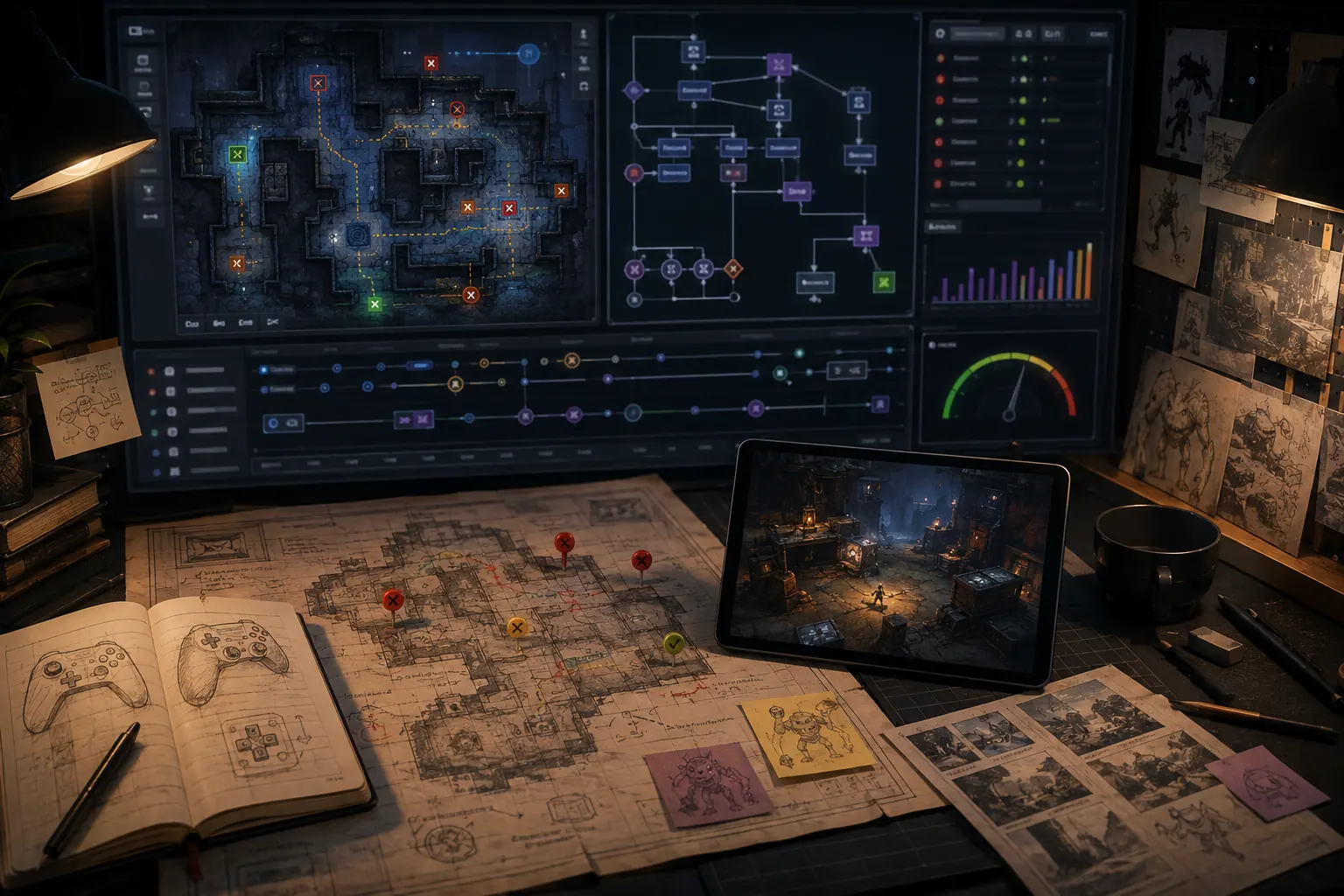
Do not start with “understand my whole game.” Give Astra a project map, one objective, an allowed-change boundary, and an explicit inspection phase. Expand context only along dependencies that the task actually touches.
Use a map before raw files
For a mature Unity project, the first artifact should be a project map: major systems, scene ownership, important ScriptableObjects or services, testing entry points, and the directories that are out of scope. This is more useful than a giant undifferentiated context dump because it tells the model what each part means before it sees implementation detail.
Separate read scope from write scope
The model may need to read more than it is allowed to edit. State that distinction explicitly. A combat change may require reading player stats, animation state, input, and networking, while only one combat script is writable. This reduces the chance that an agent “simplifies” a dependency it merely needed to understand.
Require an edit plan before tool calls
- Files and objects to inspect first.
- Files and objects it proposes to modify.
- Why each modification is necessary for the stated objective.
- Tests or playtests that prove the change works.
- Rollback point if the validation fails.
Reject convenience refactors during feature work
Large repositories tempt agents to normalize naming, move helpers, or consolidate code while touching a feature. Those edits increase review surface without proving the requested behavior. Defer architecture work to a separate task with its own tests and acceptance criteria.
Working template
OBJECTIVE: [one behavior]
PROJECT MAP: [systems + ownership]
READ SCOPE: [what you may inspect]
WRITE SCOPE: [what you may edit]
PROTECTED: [folders / scenes / systems]
FIRST RESPONSE: inspection plan only; no edits.
AFTER APPROVAL: smallest implementation + engine validation + changed-file summary.
Source and verification note
This guide was checked against OpenAI / Playco case study and updated Sep 5, 2026. Product behavior can change; current primary documentation should take precedence over this guide.
AI game change-control benchmark
When fixing or extending an AI-built game, separate diagnosis, patching and regression verification. Letting the model redesign architecture while diagnosing one bug makes the result harder to trust and harder to roll back.
- Reproduce the behavior.
- Classify the layer. Code logic, scene/object state, engine configuration, persistence/networking or test setup.
- Protect working systems.
- Patch minimally and explain the cause.
- Run the target test and neighboring regression tests.
Working on a similar coding task? Use the free Coding Agent Context Builder to turn scope, relevant files, protected areas and verification into an agent-ready handoff.
Turn this fix into a reusable system.
The method for hand a Large Unity Project to GPT-6 Astra without Letting It Change Unrelated Systems is easier to maintain when the checks, prompts and handoff steps live in one repeatable workflow. The Brightory AI Game Builder Workflow Kit packages this kind of work into reusable planning sheets, prompt structures, change-control templates, playtest checks and handoff assets, so you can carry the method into the next project instead of starting over.
Acceptance test
The original failure or requested mechanic must be demonstrably correct, the diff must be proportionate to the cause, and protected mechanics must still pass.
Decision rule
Use reproduction → layer diagnosis → minimal change → regression as separate phases.
Change-control matrix
| Failure | Evidence | Response |
|---|---|---|
| Every fix creates new bugs | Diff touches broad unrelated systems. | Restore the checkpoint and narrow the patch. |
| Cause is unclear | No deterministic reproduction. | Reproduce before editing. |
| Scene versus code confusion | Code looks correct but runtime state differs. | Inspect scene/instance state and engine configuration. |
| Feature regression | New mechanic works but earlier loop breaks. | Run protected-mechanic tests before continuing. |
Worked example: stabilize before the next prompt
Suppose adding a hazard causes token spawning to fail. Reproduce the break with a fixed sequence, identify whether the shared score/round state or scene object lifecycle is responsible, and protect the working movement and timer systems. Ask for the smallest causal patch rather than a rewrite.
After the hazard works, replay token collection, respawn, round end and any save/network path sharing the modified state. Only then accept the change and create a new checkpoint. This keeps each iteration attributable to one verified modification.
Operational notes for this workflow
Freeze a known-good checkpoint and write a reproduction or acceptance scenario before asking the AI to change the game. For bugs, record the smallest sequence that fails. For a new mechanic, state the exact event that should change state and the behaviors that must remain untouched. Avoid combining bug repair with architecture cleanup.
After the patch, run the target scenario several times and then rerun mechanics sharing the same state, scene objects or interfaces. If the fix requires a larger refactor, make that a separate, explicitly approved task with its own checkpoint and tests.
Final production checklist
- Checkpoint: is there a known-good version you can return to?
- Behavior: is the requested mechanic or decision stated in observable terms?
- Scope: are protected systems and out-of-scope features named?
- Test: is there a repeatable playtest or buyer comparison benchmark rather than a subjective “looks good” judgment?
- Evidence: are platform features, pricing or rights linked to current primary sources where those facts matter?
Do not move to the next prompt, feature or purchase decision until the current step can be explained from this record. That discipline is what turns a one-off AI result into a workflow another developer can reproduce.
- OpenAI — GPT-6 Astra release
- OpenAI Developers — GPT-6 Astra model guide
- OpenAI Developers — GPT-6 Astra model specification
- Unity — Manual
- Godot Engine — Stable documentation
Product features, pricing, model behavior and platform controls can change. Re-check the linked official documentation before relying on a current limit, entitlement or interface detail.